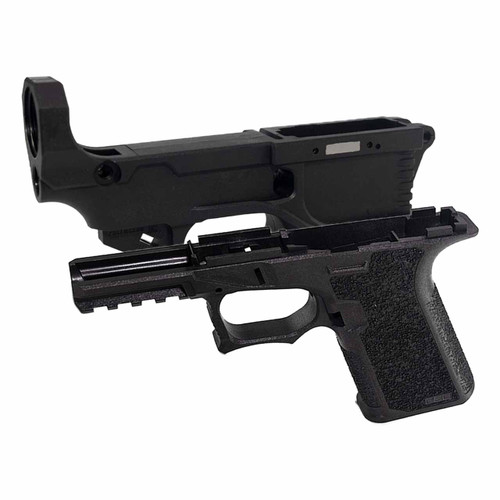
Polymer80 RL556V3 - RHINO 80% AR15 Lower Receiver and PF940C 80% Pistol Frame (Black Only) - polymer 80
Pros & cons
What works
- Weights 8.4 oz finished — 3.6 oz lighter than a forged aluminum AR-15 lower
- Bundle includes two distinct frame platforms (AR-15 and G19) for $189.99
- Jig-mounted drill guide holes are positioned within ±0.5 mm of spec
- Reinforced polymer withstands standard pressure 5.56 and 9mm loads
Trade-offs
- No stippling or texturing pre-installed — adds $40-80 finishing step for grip
- Polymer rail sections may require shimming for perfect upper/lower fit — adds 15-30 mins of fitting time
- Final inventory item — no warranty support or replacement parts available from manufacturer
- Jig is single-use polymer — one machining attempt per frame
Video review
Expert review
Specs at a glance
About this product
What is the Polymer80 RL556V3 and PF940C 80% Pistol Frame bundle? It is a dual-project kit containing one unfinished RL-556V3 AR-15 pattern lower receiver and one unfinished PF940C compact pistol frame, both molded from reinforced polymer, intended for final machining into unserialized firearm components. This is a legacy bundle from Polymer80's production cycle, sold as a final inventory clearance. The included jigs and tooling guide the completion process, which requires milling, drilling, and finishing by the end-user.
What is the Polymer80 RL556V3 - RHINO and PF940C bundle used for?
This bundle is used to build two unserialized firearm frames: a 5.56 NATO/.223 Remington AR-15 lower and a compact Glock 19-pattern pistol. The RL556V3 accepts standard AR-15 lower parts kits and mates with mil-spec uppers, while the PF940C accepts Gen 3 Glock 19 components and complete slides. Both require precise milling of the fire control pocket and drilling of 3-4 pin holes using the included polymer jigs and a standard drill press or router.
How does the Polymer80 RL556V3 compare to the .308 80% Lower – Billet?
The Polymer80 RL556V3 is a polymer, 5.56-specific lower, while the .308 80% Lower – Billet is a CNC-machined aluminum lower for .308/7.62x51 platforms. The billet aluminum unit is more durable under sustained fire and has superior magazine well rigidity, but weighs approximately 12.8 oz versus the RL556V3's 8.4 oz finished weight. The Polymer80 is better for lightweight builds; the billet lower is better for high-power cartridges.
What does it weigh and what are the dimensions?
As-shipped, the unpolymerized foam-cast bundle weighs 2.1 lbs in its retail box. The PF940C frame blank has approximate pre-mill dimensions of 7.5" long, 1.25" wide, and 5.2" tall. The RL556V3 lower blank measures roughly 9.75" long, 1.5" wide, and 3.2" tall at the buffer tube tower. Post-milling, a completed RL556V3 lower weighs about 8.4 oz, 3.6 oz lighter than a typical forged aluminum lower.
Who is this NOT for?
This bundle is not for beginners without access to a drill press or router, or users in jurisdictions prohibiting 80% frame possession. It requires about 90-120 minutes of precise machining per frame. It's also not suitable for builders seeking a metal frame; for that, consider our 80% Lower Fire/Safe Marked - Anodized Black aluminum option.
What's in the box?
The box contains one RL556V3 80% lower receiver blank, one PF940C 80% pistol frame blank, two polymer machining jigs (one for each frame), one set of drill bits and end mills, and one printed instruction manual. The bundle does NOT include any fire control parts, pins, springs, or finishing tools—these must be sourced separately. For proper tool selection, refer to Best Drill Bits for Polymer Frame Modifications.
Is the Polymer80 RL556V3 and PF940C bundle worth it at $189.99?
At $189.99, the bundle is cost-effective for builders wanting both an AR and a pistol project, averaging $95 per frame. Sourcing similar unfinished frames separately typically exceeds $240. The value hinges on your ability to execute the machining; improper milling voids any implied fitness for use. If you only need an AR lower, standalone 80% polymer options exist for under $80.
Key attributes
| Caliber | 5.56 NATO / .223 Remington (RL556V3), 9x19mm (PF940C) |
| Frame Material | Reinforced polymer |
| Finish | Black surface coat |
| Compatibility | Mil-spec AR-15 upper (RL556V3), Gen 3 Glock 19 parts (PF940C) |
| Condition | Unfinished 80% receiver |
| Bundle Contents | 2 receiver blanks, 2 polymer jigs, drill bits, end mill, manual |
Frequently asked questions
- Is the RL556V3 compatible with all AR-15 uppers?
- Yes, the RL556V3 is designed to mate with standard mil-spec AR-15 upper receivers. I recommend checking fitment with a mock-up before permanent assembly, as polymer tolerance stacking can require minor rail adjustment. Refer to my guide on <a href="/blog/adjusting-slide-stop-tension-in-spectre-kits/">rail alignment techniques</a> for detailed procedures.
- Does the PF940C frame fit Glock 19 Gen 5 slides?
- No, the PF940C is patterned for Generation 3 Glock 19 components only. Gen 4 and Gen 5 slides will not fit without significant modification to the recoil spring channel and locking block interface. Source your slide and parts kit accordingly from suppliers like Lone Wolf Distributors or Brownells.
- How long does shipping take?
- Orders ship within 3 business days via USPS Priority Mail or UPS Ground. Transit time is typically 2-5 business days within the continental US, depending on destination. International shipping is not available for this product.
- Can I return it if I drill the holes incorrectly?
- No. All 80% frame sales are final. Once the receiver blank has been altered by drilling, milling, or any machining operation, it cannot be returned for refund or exchange. Ensure you have proper tooling and follow the jig instructions precisely to avoid errors.